Q1. Is Option #2: Centralized Web Listener, shown below even valid?
Q2. How do we "register" the distributed PBDs with the centralized web listener?
Q3. How does the user identify which PDB to engage through a centralized web listener?
Background: I have been tasked with recommending an installation architecture for APEX to support our immediate goal of one PDB plugable database, but still be positioned to expand our APEX support to our ERP CDB container database at some time in the future.
As an APEX user, I am not entirely familiar with the architecture options. Please forgive any terminology faux pas I may make in describing my situation.
There appears to be two basic deployment strategies for our web listener. I want to avoid the CDB/PDB discussion for now. Let's stick to standalone PDB instances.
Option 1: Independent Web Listener.
As I understand it, we install APEX on whichever PDBs we want. We also need to install ORDS locally on each server to provide the interconnectivity between the client browser and the APEX engine. Thus, each server is both the database server and the web listener.
In this scenario, the client needs to know the URL to the specific server (unless a DNS is set up) to get to the desired application. So, in this example, the http://SERVERNAME:8080/apex has to be specific to the server you want.
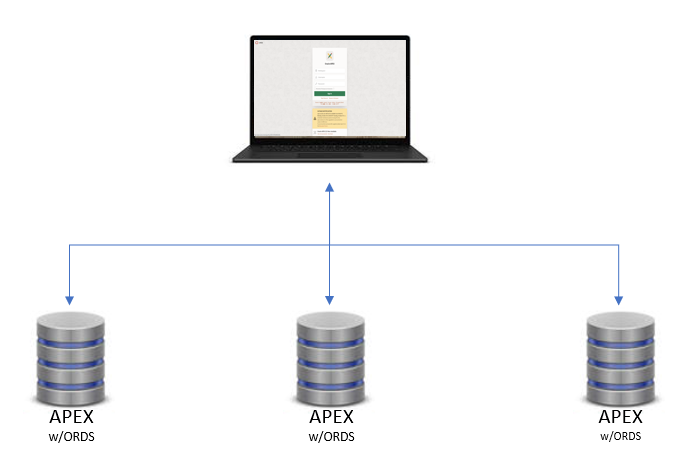
Option 2: Centralized Web Listener
Again, we install APEX on whichever PDBs we want. We then install ORDS on a central WebLogic or Tomcat server to provide the interconnectivity between the client browser and the APEX engines. Thus, the central ORDS sever acts as the common web listener and it directs traffic to the appropriate database server with its corresponding APEX engine.
How are the PDBs "registered" with the web listener and what URL is used to access one PDB versus another? For example, if we go to http://WEBLISTENERHOST:8080/apex how does it know where to go?
